Michael Mann is a climatologist and professor at Penn State University. Mr. Mann studies paleoclimate by looking at tree rings and is responsible for coming up with the famous "hockey stick" graph that is featured in Al Gore's "Inconvenient Truth" Narcimentary, and many United Nation's IPCC publications. Michael Mann also has a website at RealClimate.org. He has been in hot water of late as recently discovered emails reveal how he and his colleagues fudged the data on the "hockey stick" graph to make it look like human CO2 production is causing global warming. One email contains the quote: "I've just completed Mike's Nature trick of adding in the real temps to each series for the last 20 years. . . to hide the decline"
In response, Michale Mann has been all over the media this week explaining away the new emails and trying to sell the US public on the international climate summit in Copenhagen. Mr. Mann was on NPR and CNN today defending himself and his climate buddies at Penn State. In response to questions about the email, Mr. Mann says he says the statements about his "Nature Trick" and "hiding the decline" was taken out of context and it was just banter. Mann was then asked about the decline in public support for CO2-linked global warming. In response Mann said he felt it was unfortunate because this spirit of not skepticism but "contrariness" was at odds with an overwhelming consensus in the scientific community, and overwhelming evidence by the climate data. He likened Global Warming deniers to those who would try to claim 1+1=3. According to Mann, Not all ideas, like those who oppose a link between CO2 emissions and global warming, merit being published in peer reviewed journals. (No bias there) Michael Mann challenged those who oppose CO2-linked global warming to provide data to prove our side. Of course through the entire interview, Mann gave none of his own except to claim that the EPA, IPCC, and everyone else couldn't all be wrong.
1. We know Michael Man falsified the data in his 1000-year CO2/Surface Temp graph where he hid the global warming that occurred during the Medieval Warm Period and the Temp Declines for the past 10 years.
2. Ice Core Temp/Co2 data prove that Co2 level lag 600 years behind increases in temperature. This means that increasing temp is the driver for increased atmospheric CO2 and not the other way round. Correlation is not causation, especially when it lags behind by 600 years.
3. Increased global temperatures are caused by a combination of changing sun luminosity, sun spot activity (eg Maunder Minimum or Little Ice Age), fluctuations in the Earth's orbit around the Sun, and variability in the Earths tilt towards or away from the sun (Milakovich cycles). Because there is more water in the Southern Hemisphere, if the south is tilted closer to the sun, then you have more ocean warming which makes warmer oceans and more clouds. The warmer oceans can't hold as much diffused/dissolved CO2 which then is then is released into the atmosphere (think flat warm soda).
4. More CO2 means healthier and more lush plants. Do the experiment yourself in a sealed bell jar.
5. The Ice in the Arctic and on Mt Kilimanjaro is receding because temperature is colder. Colder oceans makes less clouds and less clouds make less rain and snow. Colder air means dryer air. Dryer air means the snow on Mt Kilimanjaro is sublimating away and not evaporating.
6. The Climate Summit in Copenhagen will sign over US sovereignty to a global government that will enforce CO2 emissions. Do you want the UN telling you that you can't buy that product or start that business because it produces too much CO2?
7. CO2 emission limits hurt the 3rd world whe need to industrialize to prosper. The token payments to 3rd-world countries is a drop in the bucket that will go into the pockets of corrupt leaders and not to the people.
8. The global warming group argue that a warmer earth will make more clouds which will trap more heat in the upper atmosphere. However, measurement shows that saturated clouds fall to lower atmosphere and there is no warming in the upper atmosphere and in spite of a prediction by 11 climate models claiming radiated heat into space would decrease with higher CO2, Dr. Richard Lindzen at MIT reports the measured data by ERBS satellite showing that radiated heat into space is actually increasing (Lindzen & Choi, GRS, 2009) with respect to suface temperature. Thus no global warming.
Mike would have you believe that Man-made global warming is "settled science" and Al Gore would have you believe that man-made global warming is the "most important moral issue of our generation." The truth is that while proper management of the environment is important, CO2 has nothing whatever causative to do with global temperatures, and CO2 is not a significant greenhouse gas.
Christopher Monckton, Viscount of Brenchley: YouTube Video 1; YouTube Video 2
BBC Documentary: "Global Warming Swindle": YouTube Video; 1,2,3,4,5,6,7,-->[[[8]]]<-- John Coleman, Weather Channel founder challenges Al Gore and Mann: YouTube Video
Don't sign the Copenhagen Climate Treaty President Obama.
Showing posts with label Environment. Show all posts
Showing posts with label Environment. Show all posts
Monday, December 07, 2009

Friday, September 28, 2007
Global Warming and Milankovitch Cycles
 New Scientist has published a second article reporting on several studies which support the theory that global warming is not due to man-made CO2 but that it is instead due to slight changes in Earth's orientation toward the sun can cause it to cool or warm in so-called Milankovitch cycles. Milankivitch cycles and other similar phenomenon describe variations in the Earth's axis as well as the extend of spherical vs elliptical shape of the Earth's orbit around the sun. Since the Southern Hemisphere's surface is comprised of more water than the Northern Hemisphere, if the Earth is tilted so, that the Southern Hemisphere receives more light, then the global oceans will warm to a greater extent.
The famous Artic and Antartic ice-core temperature/CO2 data mis-used by Al Gore in his "An Inconvenient Truth" docudrama clearly shows that CO2 elevations lag 800 years behind elevations in ocean temperature. This clearly suggests that as the oceans warmed by another mechanism, the warmer water disolved less CO2 which was released into the atmosphere. When the cause of ocean warming stopped, the atmospheric CO2 disolved back into the ocean.
These recent studies suggest that Milankovitch cycles are the main driver of global warming. Yes, we shouldn't pollute and yes, we should become more energy independent, but we need to be careful when the UN tries to tell us that all scientists are unified in the opinion that man-made Co2 is the cause of global warming. The UN was clearly trying to take advantage of an environmental issue to dictate global policy.
Wednesday, July 18, 2007
Envirocare and Energy Solutions
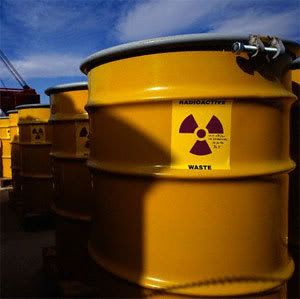 Nuclear power can be one of the cleanest sources of energy. It's the making of nuclear weapons that is dirty. Uranium is a naturaly occuring element in the Earth's crust. Uranium ore is comprised of two major isotopes; U238 and U235. What is an isotope? The smallest unit of an element that still retains the physical properties of that element is the Atom. Atoms are made up of electrons, protons, and neutrons. Protons and neutons comprise the nucleus of the atom, while electons form energy shells surrounding the nucleus. While the electons and protons do not vary for a given element, the neutrons can vary without changing the element. An example of this is carbon-14. Most carbon on Earth is carbon-12 with 12 electrons, protons, and neutrons. But a small amount has 14 neutrons instead of the usual 12. The ratio of C12/C14 is used by scientists to date ancient carbon-containing samples like fossils.
Like carbon, Uranium exist as multiple isotopes. 99% exists as U238, while less than 1% exists as the radioactive/fissionable U235 isotope. Neutrons stabilize the nucleus of an atom. U235 with 3 fewer neutrons, does not contain enough neutrons to stabilize such an enormous nucleus. Consequently, U235 atoms will spontaneously split, releasing additional neutrons and enormous amounts of energy. The brake-down products of this natural radioactive decay includes smaller atoms such as lead, and radon gas. Radon that many people worry about in the basements of their homes is the by-product of the radioactive decay of naturally occuring U235 found in the Earth's crust.
Because uranium exists mostly of the non-radioactive U238 isotope, it must be processed before it can be used as fuel in a nuclear reactor. But, separating isotopes is not an easy or inexpensive process. To purify and consentrate U235 from U238, the metal is converted into a gas which is spun in an ultracentrifuge. The sliqht difference in mass is enough to separate U235 from U238. The gas is then converted back into a metal (Zirconium) which is then processed into fuel rods for use in a nuclear reactor core. Now the purifying and processing part is the hard part. And because it's so expensive, the process is absolutely clean; not an atom of U235 is wasted. The left-over U238 is not radioactive and is used by the military as tank armor and as depleted uranium in armor piercing munitions.
Making electricity from reactor-grade uranium is easy. Have you ever seen Indiana Jones and the Temple of Doom. It's kinda like when Indiana places the Shinkara Stones next to each other causing them to glow. That's how uranium works. You simply get enough U235 in one place and it heats up. If you reach critical mass, then you get a self-sustaining reaction where neutrons from the fission of one U235 cause the fission of neighboring U235 and so-on causing a nuclear explosion. Inside a reactor core, U235 is separated into fuel rods which are separated by a series of neutron absorbing boron control rods which prevent the U235 fuel rods from overheating and melting (meltdown) or exploding. The fuel rods and control rods are placed in a pressurized water boiler. The control rods are remotely removed from inbetween the fuel rods, the rods heat up and heat up the surrounding water making steam which then is used to drive the turbins of electric generators.
You don't need 100% U235 to run a nuclear reactor. Reactor grade uranium is only 3-4% U235. On the other hand, weapons grade uranium is 90% U235. So, instead of purifying uranium to weapons grade purity, the US has adopted a cheaper and dirtier method of obtaining large amounts of fissionable material for bombs. Plutonium. Making plutonium is easy. You simply put U238 next to U235 and you make Pu239. Separating Pu239 from U238 is easy. Becuase Pu and U are different elements they have different chemical properties and can be separated using solvents. However, that creates 2 problems. First, you created something radioactive out of something that originally wasn't radioactive and Second, you have all this left-over solvent with traces of radioactive Pu239 in it.
I am living in Augusta, Ga which just so happens to be home to one of the nation's most important nuclear labatories, the Savannah River Site. The SRS is the country's center for putonium production and processing. Consequently, after decades of bomb making, SRS is full of thousands of barrels of toxic mixed waste and radioactive sludge left over from separating Pu239 from U238. Already, the barrels of high-level mixed waste are rusting, the concrete liners are cracking and radioactive solvent is seeping into and contaminating local ground water.
Fortunately, SRS scientists have come up with an ingenious way to help this situation. The process is called vitrification or glassification. Currently, the tens of thousands of barrels of solvent are undergoing a process whereby the solvent is safely evaporated away leaving only a radioactive tar or precipitate salt behind which is then encased in glass, which is encased in concrete and then steel. These new containers are being prepared for safe shipment to a permenent repository at Yucca Mountain.
 Fuel rods don't last forever. On average, a fuel rod is changed every 3 years . Within a reactor core, 1/3-1/4 of the fuel rods are replaced every 12-18 months. This is because, as the controlled fission occurs, fission products build up and poison the reaction. The fuel rods themselvs can become brittle as the uranium metal degrades into byproduct salts. The fuel rods can fracture if not replaced. This usually leaves a large percentage of unreacted U235 which some countries like France recycle. However, others are against recycling because it creates more mixed waste and radioactive salts that would also require disposal. The US produces plenty of U235 and therefore currently practices a "use once" policy for its fuel rods.
Utah is one of the largest sources of uranium ore in the world. Expensive oil and fears of global warming are triggering a new uranium mining and processing boom in Utah. Fear over nuclear energy hurt the the uranium economy in Utah during the 1980's and 90's. Uranium processing companies which operated in the 1940's and 50's left behind large tailing piles and contaminated soil which later became EPA superfund sites. One of these sites was located in South Salt Lake. Thousands of tons of tailings and contaminated soil were trucked from the old processing factory which was once outside city limits in 1950 but now was in the middle of residental section of Salt Lake City today. All that dirt was moved to a dump site in west Utah dessert.
Not long after, a company bought desert realestate nextdoor to the dump site and asked the state for permission to create a business there to dispose of medical-grade and low-grade radioactive waste. Utah approved the request and Envirocare was born. Other states like Washington, Denver and South Carolina have similar companies but Envirocare had a huge advantage. Other states taxed their businesses because they feared that after the company had made it's money, the state would be left with a nuclear waste dump which could have caused problems centuries into the future. The collected tax funds were placed in an account to cover future clean-up costs. However, Utah does not tax Envirocare because Evirocare smartly started up shop nextdoor to an existing radioactive dump site. They don't get taxed because the area was already a low-level radioactive waste dump. Consequently, Envirocare can undersell all of its competitors.
A couple of years ago Envirocare got ambitious and wanted to expand the kinds of waste it was approved to receive. It didn't want fuel rods or mixed waste; that's for Yucca Mountain. What it wanted was the contaminated equipment, gloves, and boots, and suits the people who work at places like SRS wear and use while processing the high-level mixed waste. Well, had Envirocare won approval, that would have put waste companies in Colorado and Washington out of business. So, Colorado launched one of the most impressive political campaigns since the state's ski resorts combated Utah's drink-by-the-glass initiative. Colorado sponsored a huge misinformation campaign and sent in representatives to gather names on a petition for a ballot proposal which would have put Envirocare out of business. They were successful in getting the signitures and Envirocare was forced to spead millions of dollars on TV, radio, mailers, and newpaper ads fighting the proposition. The ballot proposition failed and Envirocare won its request to receive the new types of low-level radioactive waste.
Envirocare learned an important lesson about the importance of good public relations. Like many companies, they ignored public relations, but when their competition started the negative PR campaign against them, noone in Utah knew who Envirocare was and readily believed the negative propaganda. I was suspicious when I listened to a presentation in favor of the ballot initiative during a lunch-time meeting and every other side in the presentors powerpoint had a mushroom cloud in it.
Since that experience, Envirocare has needed to transform its image. First it changed its name to Energy Solutions. And then the company started sponsoring local events such as the Salt Lake Marathon and other charitable events. But the king of them all is that they paid enough money to rename the Delta Center, home of the Utah Jazz, the Energy Solutions Center. They even started advertizing in Augusta, GA on radio and TV. A neighbor who is a nuclear engineer at SRS told me that the waste contracts were up for bid and Energy Solutions was the clear victor. In fact, Energy Solutions just purchased it's South Carolina competitor NUKEM.
Sunday, April 22, 2007
The Great Global Warming Swindle
 Happy Earth Day! Please see the "Global Warming Swindle" a wonderful documentary done by the BBC.
Newest link to the video:
1. Blinkx
2. Google
The documentary makes a compeling case against the causal link between human CO2 and global warming. Looking at the same ice-core data that Al Gore features in his "An inconvienent truth," If you actually superimpose the CO2 and temp data there is a clear 800-year lag of Co2 behind temp. This is a further reminder of that age old scientific maxim that "correlation does not equal causation." Especially something that doesn't correlated very well.
The reason why CO2 goes up with temp. is because as the oceans warm due to increased solar luminocity, gas is less soluble is warm water than cold water. So, more Co2 diffuses out of the ocean into the atmosphere without any appreciable, additional affect on atmospheric temperature. The Co2 eventually maxs out as the oceans and atmosphere reach a new equalibrium. Then as the sun's luminosity decreases and the earth and oceans cool, the CO2 dissolves slowly back into the oceans again.
Yes, there is global warming caused by increased sun's luminosity (Mars ice cap is shrinking too), and that may cause global catastrophy and yes, we should be kinder to the environment, but the causal link of human CO2 and global warming is baseless.
[see also http://ldsdoctrine.blogspot.com/2007/03/family-values-vs-global-warming.html]
Friday, February 09, 2007
Thoughts on Nuclear Energy
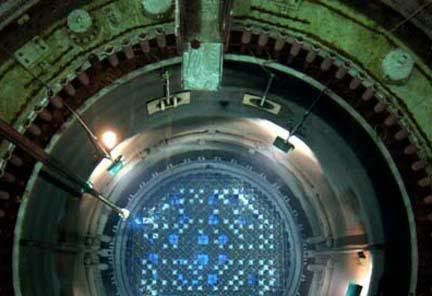 Uranium is a naturally occuring element in the Earth's crust. It is already ratioactive and is continually degrading spontaneously to form all sorts of radioactive byproducts such as radon. Uranium exists in two main forms or isotopes: 99% U238 and <1% U235. U238 is a stable isotope and not considered radioactive. U238 is denser than Lead and just slightly less dense than gold and is used by the millitary as "depleted uranium" as tank armor and in armor peircing shells.
U235, on the other hand, is the highly radioactive fissionable isotope. If you just get enough U235 together in one place at one time the spontaneously splitting atoms of U235 will give off extra neutrons which in-turn cause more U235 to split, resulting in an uncontrolled chain reaction giving off enormous amounts of heat and light. After reaching "critical mass" the U235 would create a blinding blue flash of light and then vaporize and explode into the familiar mushroom shaped cloud. However, this reaction would only be about 1% efficent because the vaporized metal would quickly dissipate; breaking the chain reaction.
Nuclear bombs are designed to be more efficent by using a polonium/berylium core to add extra neutrons to the reaction and U238 shielding. In a more controlled setting, if you simply purify U235 into a 6-8 sub-critical fuel rods and just get them close together they will get hot, make steam, which is used to make electricity. It's just like how the Shankarah Stones in Indiana Jones and the Temple of Doom glow when they are next to each other. It really is that easy, but you wouldn't want to hold hot U235 fuel rods.
Neutron absorbing control rods are placed in-between the U235 rods to absorb extra neutrons and prevent the core from getting so hot the fuel rods melt down, flow together into a super-critical mass and explode into a hiroshima-like mushroom cloud, or vaporize all the tritiated heavy water and blow the roof off the building that is housing the reactor (Chernobyl).
A new design of nuclear reactor called the pebble-bed reactor uses spheres of U235 encased in a shell of neutron shielding/slowing material (boron). The reactor is run by simply adding more or less spheres to the bottom of the heavy water tank. The shielded spheres are designed such that even when surrounded by other spheres, they can never get hot enough to melt down. They will heat up and make steam, but thats it. More pebbles makes more steam, and more electricity, but the U235 spheres will never get so hot that they melt.
U235 should be considered a clean way of producing electricity bacause it does not create more ratioactivity. U235 is already in the ground and highly radioactive. Using it to generate electricity requires processing it and concentrating it and then having to dispose of the same amount of radioactive material that was originally mined out of the Earth. Using heavy water (D2O) to cool and shield the reactor does create some tritium but its is reliatively short-lived.
U235 is very difficult to separate from U238. It requires very expensive and sophisticated gas-diffusion ultracentrigation techniques. However, at the same time, the process of separating the U235 isotope from U238 is very clean and generates almost no waste. The leftover U238 is used as tank armor. On the other hand, if you take that same non-radioactive U238, and put it in a reactor next to U235, it will capture a neutron and become the unstable and highly radioactive element plutonium (Pu239). This is much easier to separate from U238 with solvents but much more problematic. If you use solvents to separate U238 and Pu239, then you are left with hundreds of thosands of gallons of solvent with traces of Pu239 in it.
The Savannah River Site in CSRA Central Savannah River Area on the border of South Carolina and Georgia is one of the country's centers of plutonium production. Since the cold war, the site has been innundated with thousands of barrels of left-over solvent with radioactive residue known as "mixed waste." The site has pioneered a process of vitrification or "glassification'" in which the solvent is slowly and gently evaporated off and the remaining radioactive sludge, residue, and/or precipitate is encased in glass which is then encased in concrete which is then encased in a stainless steel jacket.
Although innovative, the production of plutonium from U238 is creating additional radioactive material from matter that was not originally radioactive. However, Pu239 will continue to be produced because it is the preferred fissile material used in US atomic warheads. It is my opinion that Atomic energy from processed, concentrated U235 using the new pebble-bed reactor design is both safe and enviromentally friendly. Absolutely no carbon dioxide or other polutant (except tritium) is produced in the the reaction. I encourage the US to focus more on Uranium-based reactors over Plutonium-based atomic energy.
Subscribe to:
Posts (Atom)


