
Monday, July 02, 2007

Admissions Formula for the University of Utah School of Medicine for the BYU Pre-Med Student

I recently spoke with a BYU alumnus and past Utah resident who is currently in an MD-PhD program but held some resentments about the admissions process at Utah as well as the application process at BYU. I don't think Utah should be responsible for all the hard feelings felt by every applicant who was not accepted. However, over the last few years, I have had similar conversations with dozens of people. Although some of this resentment is unavoidable, I think the fact that such resentments exist, especially by people who go on to be talented physicians, is a negative for Utah's image. I think some of the preventable resentment comes from a mistaken sense that the admissions process is unfair; and that Utah does not accept the "most qualified" applicants. I think this sense of unfairness comes from misunderstanding of what Utah considers "qualified." Therefore, this article details some of my thoughts on how Utah could, hopefully, prevent some of this resentment.

Most, if not all, of the information that a pre-med at BYU learns about what Utah is looking for comes from Dr. Bloxham and his "intro into medicine" course. When I applied to Utah, I was fortunate to have grown up next door to the Medical School and had the benefit of some insider information from several current Utah medical students and alumni. When I was at BYU, It seemed the things Dr. Bloxham emphasized were not exactly congruent with what my neighbor's were saying Utah emphasized. Luckily, I listened to my neighbors. But, because of this disconnect of goals and expectations, there are a large number of BYU students who get an excellent committee letter from Dr. Bloxham but end up not scoring well with Utah. Consequently, there exists a population of BYU grads who go on to have wonderful medical careers but somehow feel cheated because they feel like they did everything that Dr. Bloxham emphasizes better than everyone else but didn't get into Utah. Therefore, they conclude that Utah must not accept the best students.

Now this feeling that Utah does not accept the best students is not a trivial matter. It was such an issue while I was in medical school that the first lecture I received as a medical student focused on all the accomplishments and diversity of my classmates. I remember Dr. Judd (past Dean of Admissions) going through a list saying "Someone in this medical school class did such-and-such" and "Someone else in this medical school class became so-and-so." The presentation was very memorable. However, despite the great achievements of my classmates, several years later I recall several students needing counseling to deal with the sense of inadequacy, which was a byproduct of the Utah legislature's audit of the SOM's admission's process. So, I think that communicating very clearly about the admissions process is important not only for the image of the medical school but also the for the overall morale of the student body.

Now, I understand that Dr. Bloxham is focused on getting as many pre-meds accepted into medical school as possible and not just getting students accepted to Utah. I'm sure, in his mind, focusing on what Utah is looking for may not be the best strategy. As I see it from Dr. Bloxham's perspective, Utah is going to accept a certain number of BYU students regardless. And after Utah takes its 30-40 students, he is left with the other hundred or more qualified pre-meds. So, Dr. Bloxham has an admissions formula which maximizes the total number of pre-med students accepted to medical school overall. His formula is not designed to maximize the number of students accepted to Utah.

Dr. Bloxham's Emphasis:
1. MCAT (score 10 or better in each section)
2. Science GPA: (3.5 GPA or better)
3. Brief research experience (semester in a lab)
4. Brief clinical experience (shadow a doctor)
5. Brief volunteer experience (go on a medical vacation to Africa)
6. Pick up a quick talent (run a marathon).

Utah's Formula (Each variable is assigned a value from 1-4 based on subjective or objective criteria):

Average (MCAT + GPA + Clinical + Research + Volunteer + Diversity/Talent + Recommendations + Personal Statement + Interview + Economic Hardship)

All of Dr. Bloxam's criteria are a part of the Utah admissions equation. And, if a pre-med student does all these things he is very likely to get accepted to a medical school somewhere but probably not at Utah. While Dr. Bloxham's formula focuses on what pre-med students can do in the short term to "pad" their résumé's, Utah's emphasis seems to be looking for more "long-term" involvement, commitment, and contribution in a research, clinical, volunteer, or other activity. As my neighbor put it, "Utah is looking for someone who has really done something." You will quickly notice that the MCAT and GPA only account for 20% of the overall score. Knowing this early on, I was able to direct my efforts more into "long-term" involvement into several extracurricular areas. Even knowing Utah's formula, I was rejected my first year, initially rejected the second year, appealed, wait-listed, and then eventually accepted.

Consequently, the Bloxham formula creates a large number of excellent pre-med students who may have a 40 MCAT and 4.0 GPA; who have also done their semester in a lab, and shadowed a doctor a couple of times, ran a marathon, and then went to Africa and did some skin grafting for a couple of days and then hiked Mount Kilimanjaro; who think that there is a seat up at Utah with their name on it. These same students end up being greatly disappointed and resentful when other students with a lower MCAT and GPA get into Utah instead of them. They get a great letter of recommendation from Dr. Bloxham, they get into medical school somewhere else, but not at Utah.

On the other hand, the most attractive applicants from Utah's perspective are those who not only satisfy Utah's MCAT and GPA requirements but also demonstrate "long-term" participation, commitment, and contribution to research, clinical, volunteer and other extracurricular activities. Because of their "long-term" participation, these applicants are more likely to get several outstanding letters of recommendation, have a better personal statement, and interview better. The applicants who contribute to "long-term" extracurricular activities will score higher in these areas because they will be able to both write and speak with passion about their endeavors. Passion is the kind of thing that is extremely difficult to fudge in a personal statement and near impossible to fake in an interview.

To prevent further misunderstanding and resentment, I recommend that representatives from Utah SOM speak annually to the freshman and junior pre-med students at BYU during Dr. Bloxham's "intro into medicine" and clearly make a distinction between the elements which earn points in Dr. Bloxham's system and those "long-term" activities which will not only make these students more attractive applicants at Utah, better physicians, and better overall citizens in their communities.

Saturday, June 23, 2007

Rule #1 Investing

At some future point I hope to be able to start putting aside money for retirement. I am currently finishing a medical residency and together with a mortgage, school loans, and a car loan I am over 300,000 in debt. When I finish residency and get a real job, I am hoping to get into a very modest home and my goal is to be completely out of debt in 5 years. Now some would say that is unwise considering the low interest rates on my school loans. However, I feel the right thing is to pay debts immediately. That said, I am looking forward to starting on saving for retirement. Accordingly, I have been working on my financial literacy. Finance is a rich world with a complex language and culture. All these new terms: capital, assets, equity, price earnings ratio, book value per share, and earnings per share. When I look at all these terms a quote from Johann von Neumann comes to mind, "when it comes to math you don't understand things, You just get used to them." I think the same thing can be said of finance.

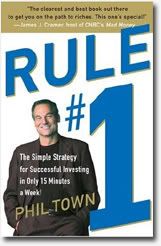
My wife learned of my interest in finance and checked out a great new book to help me "get used to" the concepts in investing. The book is entitled "Rule #1" by Phil Town. Phil made a fortune on investing in the stock market and is now making a fortune selling his book and teaching others his stock market investing formula. Actually, Phil's formula is not Phil's. His strategy came from none other than Warren Buffett. Warren Buffett, after learning this strategy from Benjamin Graham and David Dodd while attending Columbia University, went on to become the single most successful investor of our day and went on to became one of the richest men in the world; second only to Bill Gates.

Mr. Town begins his book by telling his own American rags-to-riches, Horatio Alger story. Mr. Town started out as a river guide working for Outward Bound, an adventure wilderness rehab program for troubled teens and adults. On one occasion he was guiding a group of VIP donors down the Colorado River and just narrowly escaped dying in the most dangerous rapid on the river. Afterwards, one of the VIP's expressed his appreciation to Mr. Town for saving his life (or not ending it) and offered to teach him how to invest in the stock market. Phil Town started out with only $1000 and 5 years of "Rule #1 investing" later, he was a millionaire.

So, what is Rule #1? Simply put, Rule #1 is: Don't lose money. And as Warren Buffett says, "Rule #2 is: Don't forget rule number one." So, how do you assure that you never lose money in the stock market? First, Mr. Town dispelled some very pervasive investment myths.

First, many money managers teach that to avoid risk, you should diversify in bonds, mutual funds, and spread your money across a huge swath of random companies. According to Town, Buffet, Graham and other so-called "value investors," they believe the best way to avoid risk is to invest in a few meaningful, healthy, well-managed, under-valued companies. Town argues that bonds, which earn 5%, take 20 years to double. 5% hardly covers for inflation. Mutual funds and index funds make 10% but are subject to the ups and downs of the stock market. The Dow Jones, for instance, has long periods with no change punctuated by a few brief ups and downs. "Rule #1" investing, on the other hand, promises at least a 15% return regardless of whether the stock market goes up down or stays the same. As you will see below, the difference between 10% and 15% is huge.

The second myth is that you need someone else to manage your stock portfolio. Town says, no way. Thanks to the Internet, the information and tools that were once only available to the experts is now available to everyone. Town likens the influence of the Internet to finance with that of the printing press and religion. For the first time, everyone has access to the financial statements of all the best companies in the world, enabling us to see which companies are profitable, sustainable, well-managed, and undervalued. If we then invest in only these low-risk companies then we are guaranteed to earn healthy 15% returns.

So, what makes a company a "Rule #1" company. Town says that a company worth investing in has to satisfy the 4 M's. First, the company must be meaningful to you. That is, you should be familiar and understand what the company does. Also, you should only invest in those companies you feel are a benefit to society. This makes sense long term as harmful companies are usually only out to make a quick buck and then end up crumbling (i.e. Enron). You should be proud to be a part-owner of the company itself and not just consider yourself an owner of stock.

Second, the company needs to have a moat. A moat is a company's protection from competition. Effective moats can be a brand, patent, low-price, or monopoly. Other protective moats are companies whose services are offered elsewhere but switching to another company is too much of a hassle (H&R Block).

The third M is management. A great company is lead by a great CEO and board. Signs of great management include a CEO who receives a modest salary, does not issue stock options, and has little debt. Other signs of good management are CEO's who talk candidly in their quarterly summaries about real problems, takes responsibility for them, and then talks about how the company is going to solve them. Another sign of good management is a company who buys shares of its stock back from time to time.

Town also gauges a companies health though several calculation he calls the "Big 5 numbers." Basically, he looks up on the companies financial summary available on MSN, and looks for consistent, double-digit growth in Sales, Equity(BVPS), Cash, Earnings Per Share(EPS), and Return on Capital(ROC). If the company is consistently experiencing 15-20% growth per year in all these areas then their stock will likely experience similar growth.

The 4th M is where the value in "value investing" really comes into play. The 4th M stands for "Margin of safety." This has to do with the principle of only buying stock at 50% off. Many finance experts teach that the price of a stock always reflects the value of a company. Town says, not so. The market usually reflects the value of a stock but, as the Internet bubble shows, the market can act irrationally and emotionally and over- or under-value stocks from time to time. So, buying stocks at a discount requires calculating the correct price of the stock and then patiently waiting for the price to fall at least 50% below its "sticker price."

E.1: Stock Price = P/E * EPS
E.2: EPS = Net Earnings / Outstanding Shares
E.3: P/E ~ 2 * Projected EPS Growth Rate (Historical Equity or BVPS Growth Rate)

So, how do you determine the sticker price of a stock? First, according to equation (E.1), you have to know the current EPS. Then you need to know the projected EPS growth rate over then next 5-10 years. You can calculate this from the historical equity growth rate (BVPS not EPS) or by using the analysts projections which are usually a tad more conservative. Using those values you than can calculate the future EPS in 10 years. The next step is to obtain a value for the future PE which is either the current PE, or 2 x the projected EPS growth rate (historical equity growth rate (BVPS)). Using the most conservative numbers and equation (E.1) you can calculate the projected price of the stock in 10 years. Then assuming a minimum acceptable return of 15% per year, you can back calculate what the stock should be priced today. 50% of this "sticker price" is the discounted MOS price.

[These calculations can be made automatically at the Rule#1 Investor website or you can use the rule of 72 which tells you how many years it will take for a number to double for a given % compounded annual growth rate: e.g. 72/35% = 2 years, 72/20% = 3 years, 72/15% = 5 years, 72/10% = 7 years; 10 years at 15% = 2 doublings.]

Here is a sample calculation. Lets say Microsoft has an EPS of 1.5 and a projected EPS growth rate of 15%. That means in 10 years the EPS will double twice according to the rule of 72 (see above). So, the future EPS will be 1.5 * 2 * 2 = 6. The future PE can be assumed to be the same as the current PE, or 2 times the projected EPS growth rate, which would be 15% * 2 = 30. Then, using Equation (E.1) we can calculate the future stock price as 6 * 30 = $180/share. Then we can approximate the appropriate present sticker price by using the rule of 72 and assuming a 15% minimum growth rate (always use 15% here). That means that in 10 years the stock price would have doubled twice, every 5 years. So presently, the stock should only be worth: $180 / 2 / 2 = $45/share. Then calculating the Margin of Safety, $45 / 2 = $22.5/share. So, even though Microsoft is doing well and is a consistent gainer, a Rule #1 investor would not buy stock until its price fell to around $22.5/share.

So, once you know the MOS price of a stock, Mr. Town recommends patiently holding your retirement savings (IRA) in short-term bonds while you monitor a handful of "Rule #1" companies until their stock inappropriately, emotionally, or otherwise irrationally falls near their MOS price. Then you go all in and ride the stock all the way back up.

I should point out that stocks rarely ever get much above $100/share except if your Google because big stock prices seem to scare people away or otherwise make it difficult for people to buy stock. Consequently companies will routinely split their stocks which halfs their price per share. Long term grafts of stock prices adjust for, rescale, and consequently hide these splits so it appears like stocks had small initial growth and then just shot up in the last 10 years.

Some people just buy cheap stocks on big companies that are hurting hoping they will turn things around. This strategy is risky and not "Rule #1" investing. If you have done your homework and the company has it's 4 M's and great Big 5 numbers and therefore is a great "Rule #1" company, you can be certain the stock price will rebound.

US T-Bills at 5% double every 2o years. So, $100,000 only becomes $200,000 at retirement age. 5% of $200,000 only generates $10,000 per year while in retirement. Mutual and Index funds average 10% per year if there isn't a recession or stock market crash. So, $100,000 doubles every 7 years. So in 20 or so years that's 3 doubles. $100,000 becomes $200,000, becomes $400,000, becomes $800,000. During retirement, that mutual fund investment would generate an annual salary of $80,000. If you sell and transfer to bonds at that point at 5% then your annual salary becomes $40,000. And that is before taxes for a 401K.

But lets assume instead, that you earn a 15% per year return with a "Rule #1" company. That same %100,000 would double in only 5 years to $200,000. And over the next 15 years it would double again to $400,000 , and again to $800,000, and yet again to %1,600,000. If you stopped there and left the money invested in your "Rule #1"company and lived off the 15% growth; your investment would generate an annual salary of $240,000. That kind of money would provide a rather comfortable retirement where you would be free to travel, spoil the grand kids, and contribute to numerous humanitarian and missionary projects. The difference between the average 10% return and the target 15% return makes all the difference.

Mr. Town hopes you never have to sell your stock. Your "Rule #1" company should continue to earn money far into the future. But, the Internet empowers the individual investor in selling stocks and not just in buying stocks. See, mutual fund managers cannot protect your money from a stock market downturn. They manage so much money, (14 of 17 trillion dollars) they just can't sell all their shares in a company overnight. That would trigger a panic, and cause a stock to tank even lower. So, if he wants to sell, your mutual fund manager has to sell slowly over weeks, months and even years. (Warren Buffett is cashing out of Coke, GEICO, Gillette etc by transferring his wealth to Bill Gates Foundation over the next 10-20 years). Consequently, If the stock market tanks overnight, you and your mutual fund manger tank with it.

However, the individual investor can operate swiftly and anonymously. When dealing with hi- or mid-cap stocks (Blue Chip), the buying and selling a couple hundred or thousand shares won't affect the price at all. Therefore, you can sell at any time. If you set up an account with an online broker like Etrade or TDAmeritrade you can set automatic sell signals. So, if anything happens suddenly your money is safe. Also, the tools at MSN and Yahoo allow you to see more gradual changes. You can actually watch the big fund managers buy and sell.

When viewing the chart for Microsoft on MSN or Yahoo, click on MACD (12-26-9) or (8-17-9). As you watch the MACD line diverge from the EMA line you know that a fund managers slowly buying stock or selling stock (solid green bars). I prefer to view the YTD chart with MACD and moving average displayed. At $10 per stock trade you are free to sell when the stock is high and appears to be turning downward (MACD intersecting EMA) and to buy again when the MACD is developing a positive slope and again crosses EMA (especially with a large positive or negative slope). Mr. Town says he may buy and sell a "Rule #1" stock 1o or so times a year which maximizes his gains throughout the year. And since you are only watching 1 or a couple stocks, managing them only takes a couple of minutes a day or 15 minutes a week. Or if that's too much, simply place an automatic sell and forget it.

So, it sounds simple. Maybe too good to be true. But so far I can't see any flaws in the logic. I am currently reviewing companies I know. I am in the medical field so I have some familiarity with the pharmaceutical companies and medical equipment companies. I use a computer and am familiar with the companies that sell the hardware and software. I also go to the store and am familiar with retail. Mr. Town suggests starting slow by creating a watch list of "Rule #1" companies and then creating a virtual portfolio at MSN or Yahoo. He recommends practicing these techniques and seeing if they work before I actually trying it for real.

Wednesday, June 06, 2007

An End to Poverty

We all want to live in a better society. It seems everyone has their own ideas on what our society should look like. First off, how do you define the ideal society? The definition is really very simple. An ideal society has no poverty. I am not just talking economically. Every person has a set of needs which includes temporal, spiritual, emotional and psychosocial aspects of their lives. Temporally speaking, every person needs proper nutrition, healthcare, housing, and protection. Spiritually speaking, every person needs to feel like they are living according to their conscience and in a manner that God approves of. Their spirituality should help them deal with adversity and death. Psychosocially and emotionally speaking, everyone needs to feel like there is purpose in their life. They need to belong and feel their life is of value.

You may not consider spiritual and phychosocial needs of much importance. However, consider what happens when people don't feel needed or valued. They feel depressed and negatively stressed. And when people feel depressed, hopeless and negatively stressed they well seek to cope. And if they feel hopeless, then they will feel like no amount of personal effort and no amount of divine intervention could ever make their situation better. Consequently, they may turn to unproductive, unhealthy, unnatural and destructive behaviors to escape from the feelings of depression caused by their unmet needs.

To escape feelings of hoplessness, people turn to addictive behavior. People turn to alcoholism, tobacco, illicit drugs. People turn to increased sexual behavior and pornography. These behaviors can then lead to health problems, mental illness, suicide, crime, and injury. I work in an ER and I see the results of poverty on a daily basis.

One of the biggest contributers to poverty in the US is illigitamacy. A single mother simply is less likely than a married couple to have the resources available to satisfy the needs of her children. In recognition of this fact. Some advocate birth control and abortion. But this is a failed policy that fails to treat the cause or even the symptom. My wife attended an inner-city school in Atlanta and she said you couldn't pass out enough birthcontrol because many girls she knew got pregnant on purpose. They didn't get pregnant because they didn't know how not to get pregnant. They wanted to be pregnant. Why? They wanted to feel needed. They wanted to belong. They wanted to feel like they had a purpose and were of value.

A new Gallup poll demonstrates the erroding of morality and tradition family values in the US. Especially among those that consider themselves liberal. However, the poll also shows when it comes to the morality of sex before marriage, the vast majority of both liberals and conservatives feel that such behavior is moral. However, despite birthcontrol and abortion, people who have sex make babies. And those babies who are born are more likely to be born to parents who didn't want them, or who are mature enough to care for them, or who are not commited to each other. These children are denied their right to be born into a family with both a mother and a father who are committed to each other and who have the resources available to take care of their individual needs. In many cases the reason the pair were having prematarital sex might have been to cope with their unmet needs. Now pregnant, these same needy, often emotionally bankrupt individuals are expected to provide for the needs of another person.

There is both a left-wing and right-wing conspiracy in the county. We are fighting a battle of political extremism in the US. Liberal secular progressives as well as neo-conservatives both have their right-wing and left-wing conspiracies. Liberals feel like the government can fullfil everyones needs. Yes, the government can provide some symptomatic relief. But, the government programs and welfare themselves are not designed to treat the root cause of poverty.

The family is considered the fundamental unit of society. What does this mean? It means that the family with a father who works outside the home and a mother who works inside the home is empowered with all the resources to fulfull all the temporal, spiritual, emotional, and psycho-social needs of it's members. Even when it comes to education needs, home-schoolers have shown that children can be effectively educated at home. The goverment is expected to institute laws which reflect and protect the ideal moral values of society and support and empower the family in it's important role.

At the same time. The far-right also contibutes to poverty in the US Business through social-darwinism. They practice "survival of the fittest." These are people who say "let the markets work" because the market just happens to benifit them. I'm not anti-capitalist. But, when business practices are cut-throat or look for loop-holes in the law and exploit others for power and wealth; this behavior is wrong. Just because an action is technically legal does not make it ethical or morally right. The constitution expects us to govern ourselves to a higher standard. Infortunately, our laws get more and more complex as more and more people are caught lying, cheating, stealing, and otherwise taking advantage of their neighbor to make a buck. Greed is the error of the far-right just as much as sexual immorality is the error of the far left.

Ilegal immigration is a good example. Businesses in the US have always attracted illegal immigrants. Immigrants are cheap labor. Businesses who employ them are not technically breaking the law. However, businesses can employ these low-paid workers and in many cases do not provide medical, disability and retirement benifits legal citizens expect and need. Immigrants come to this country because they want a better life. They have unmet needs but then support a huge illegal industry of illegal immigrant trafficing which is associated with an array of dangerous consequences.

The clash of the far-right and the far-left is over control of the government. The far-left wants to institute laws which protect their so-called "individual freedoms" to have sex with whomever, whatever, whenever they want or to smoke or otherwise shoot up whatever they want. They say, as long as what I do doesn't hurt anyone else, then the goverment should stay out of it. But no man is an island and all these descructive behaviors such as substance abuse and casual sexual activity have clearly documented ill-effects on our society. The far-right likewise wants to be free to take advantage of their neighbor. "Let the markets work". "Survival of the fittest." "It's not personal, it's business." These are the mottos and reflect the behavior of the far-right.

Because business does not respect it's workers. Workers do not respect their companies. Workers no longer expect to work with the same company. We see in sports, a player moves from one team to another following after the allmightly dollar. We all have the attitude, I'm just looking out for myself irregardless of how it affects other people or the agreements we have made in the past. Unfortunately, we live in a self-centered, self-absorbed, dis-respectful, irreverent society were people expect instant gratification and live only for themselves. This attitute is refected in the severe epidemic of consumer dept and personal bankrupcy.

To end poverty, we need to return to our morals before the sexual revolution. We need to return to our traditional sense of honor. We need our great institutions of this country to conduct their affairs with principaled ethics and integrity. We need business leaders who take responsibilily and respect their workers and the community so that the community and their workers will in-turn respect the great institutions and companies of this country. People will feel needed and valued as a part of such a wonderful institution which also allow their workers to satisfy the temporal needs of their families. To end poverty and live in peace and prosperity, our country needs to return to its traditional ideals of morality and integrity.

Wednesday, May 16, 2007

Mitt Romney for President

The 2008 presidential race is already heating up. The GOP candidates have now participated in their second public debate. FOXNEWS moderated last night's debate in Columbia, SC preceding the nation's first presidential primary election. After having studied each candidate, Mitt Romney is the clear favorite for my vote. What do I like about him and why do I think he is the best candidate for president? Look at this guys insane resume!
1. He excelled in his education.

Mitt Romney didn’t just attend an IVLeague school and coast by. After attending Stanford for 2 semesters and serving an LDS mission he transferred to Brigham Young University, where he was valedictorian, earning his B.A. summa cum laude in 1971. In 1975, Romney graduated from a joint JD/MBA program coordinated between Harvard Law School and Harvard Business School, where he was named a Baker Scholar. He graduated cum laude from the law school and in the top 5 percent of his business school class.
2. He is a proven leader and a financial genius.

Romney is a former vice-president and then CEO of Bain & Company. While working as a vice president, Romney broke away and formed Bain Capital. Bain Capital was an immediate success while Bain & Co. approached bankruptcy. Only a few years after founding Bain Capital, Mitt was asked to rescue Bain & Co. Romney accepted and merged the two companies. Under Mitt's direction, Bain & Co. became one of the most successful private equity investment firms worldwide.

Next, Romney was asked to rescue the almost bankrupt Salt Lake 2002 Winter Olympics. After the bribery scandal, the games had lost nearly all their sponsorship. With Romney as CEO, the games ended up one of the most profitable Olympic games of all time. Salt Lake City was left with several state-of-the-art Olympic venues and a trust funds to cover their upkeep (unprecedented!).

After the Olympics, Mitt Romney (a republican) was elected Governor of Massachusetts (the bluest of the blue states). The state was in a financial crisis whose citizens looked to Mitt Romney for financial salvation. In 4 short years, Mitt Romney turned a $3 billion state budget deficit into a $1 billion surplus; without raising taxes.

Romney also instituted one of the most ingenious healthcare programs ever. From 2001-2004, Massachusetts experienced a double-digit rise in the number of uninsured due to rising healthcare premiums. Without raising taxes, Romney expanded state Medicaid to subsidize low-income residents in purchasing their own private insurance. Since 2005, "Romney-care" has achieved double digit decreases in the number of uninsured. And, what is all this progress causing the taxpayer? Not a dime! By helping people afford to purchase private insurance, the individual citizen pays some of the costs, and are also then able access preventive medical care instead of showing up to the ER with an expensive medical crisis. Through "Romney-care", the state is using the same state Medicaid dollars more efficiently.

3. He is not a career politician.

Mitt is a true Washington outsider who’s a relative newbie in politics (just 4 years). However, as a former CEO and governor he has demonstrated that he can manage enormous, and complex institutions. Through these experiences, Mitt has developed the necessary leadership skills necessary for the President of the United States. The most important skills being the ability to set worthy goals, see the path to achieving them, and then to inspire others with that same vision.

4. He exemplifies moral integrity and family values.

Mitt Romney has the clearest vision for America. When he says he wants a stronger America, a better America, with stronger families, better education, and more prosperity; Mitt's life exemplifies that vision. His vision of America is not some theoretical Utopia. Mitt is actually living his American dream. And he wants everyone to share in the prosperity and happiness he has enjoyed in his family life, career, and civic life.

So, As I consider who will win my vote for President in 2008, I first look at the biggest issues facing this country: national debt, Medicare, social security, national security, healthcare, immigration, disintegration of family values. Then I look at the qualification of the applicants. After careful consideration, the choice is clear. In my mind, only Mitt Romney has the credentials to tackle our foreign and domestic problems and lead a stronger America into the 21st century.

Sunday, April 22, 2007

The Great Global Warming Swindle

Happy Earth Day! Please see the "Global Warming Swindle" a wonderful documentary done by the BBC.

Newest link to the video:
1. Blinkx
2. Google

The documentary makes a compeling case against the causal link between human CO2 and global warming. Looking at the same ice-core data that Al Gore features in his "An inconvienent truth," If you actually superimpose the CO2 and temp data there is a clear 800-year lag of Co2 behind temp. This is a further reminder of that age old scientific maxim that "correlation does not equal causation." Especially something that doesn't correlated very well.

The reason why CO2 goes up with temp. is because as the oceans warm due to increased solar luminocity, gas is less soluble is warm water than cold water. So, more Co2 diffuses out of the ocean into the atmosphere without any appreciable, additional affect on atmospheric temperature. The Co2 eventually maxs out as the oceans and atmosphere reach a new equalibrium. Then as the sun's luminosity decreases and the earth and oceans cool, the CO2 dissolves slowly back into the oceans again.

Yes, there is global warming caused by increased sun's luminosity (Mars ice cap is shrinking too), and that may cause global catastrophy and yes, we should be kinder to the environment, but the causal link of human CO2 and global warming is baseless.

[see also http://ldsdoctrine.blogspot.com/2007/03/family-values-vs-global-warming.html]