Friday, September 21, 2007

2 Meter VHF HT Handheld Ground Plane, Tiger Tail, Lambda Wire Antenna

I have been an Amateur Radio or "HAM" radio operator for over 2o years. My call sign is KB7BXP. I was about 10 or 11 when I first got into the hobby. However, I haven't been active in the hobby for the last 12-15 years until the last couple months. I needed something to do while making a long 1 1/2-hr commute. Amateur radio has been the perfect answer to keep me awake on the long drive home after a 12-hour shift.

The first radio I purchased was the Yaesu VX-170 2-Meter Handheld or HT. This is a great little radio. However it comes with the traditional "Rubber Duck" antenna that has only marginal performance. I also purchased a 5/8 Mag-mount external antenna to use while I drive. But I wanted to extend the performance of my HT while using the radio around the house or when walking around town or the neighborhood.

That's when I read about a simple little antenna modification that greatly increases the receive and transmit capability of any handheld radio. This antenna modification is referred to as a "Tiger tail," "Rat Tail," Lambda wire, ground plane, or counterpoise antenna. This modification simply comprises a 1/4 wave length of wire attached to the body or base of the antenna in some fashion. After a quick trip to the Walmart Automotive section and 10 minutes of cutting and crimping, the project was complete and the results speak for themselves. The following pictures describe the project.


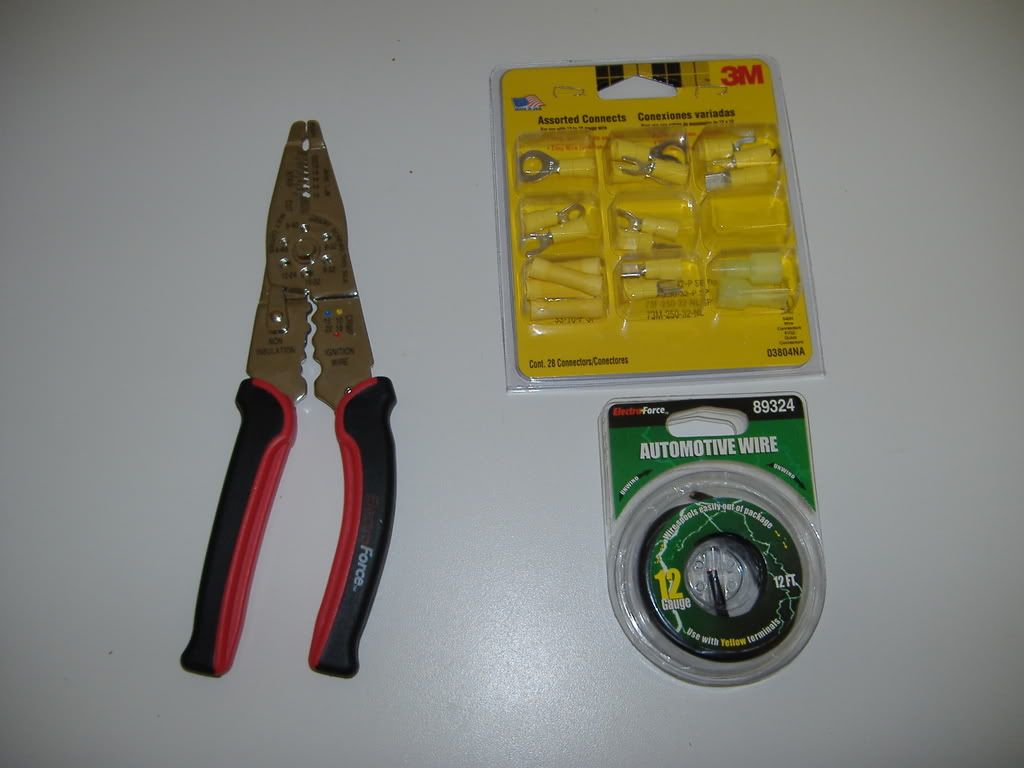
Needed Supplies:


Wire Cutting, Stripping, and Crimping Tool.
Spool 12-gauge automotive electrical wire.
Package automotive electrical ring connectors.


Making the Antenna:
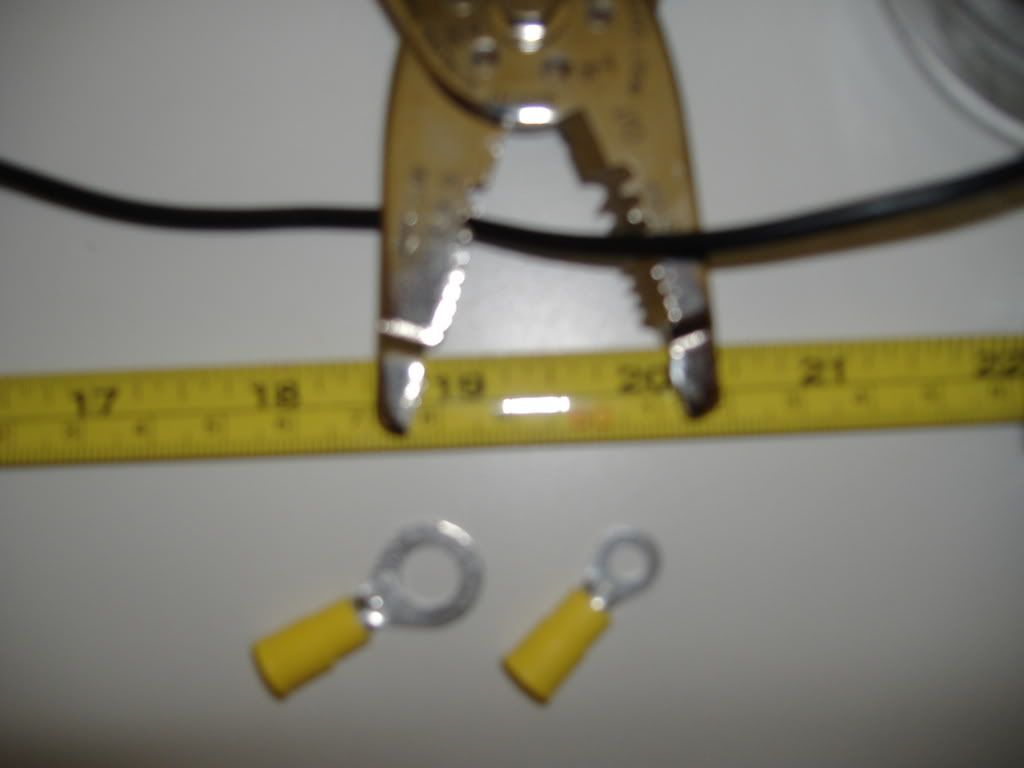
Cut one or odd number of 1/4-wave lengths of wire.
Strip 1/4 cm of outer plastic sheath from one end.
Place stripped end into ring connector and crimp yellow plastic section X 2.


2-Meter 1/4-wave at 146 MHz = 20 1/4 in. But anything close such as 19 1/4 or more will work.


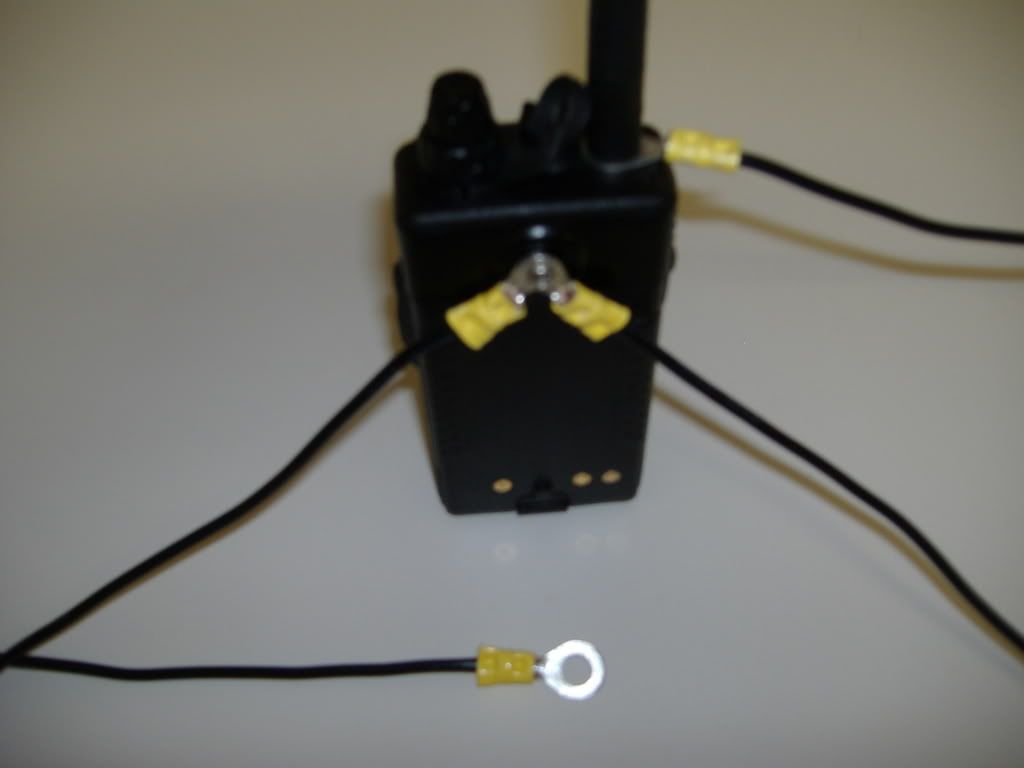
Connecting Antenna:

Attach ground plane wires to base of SMA connector or from belt clip screw on back of radio chassis or battery case.

Any kind of wire can do. I have also used twin-lead speaker wire and attached 3 1/4-wave wires to one ring connector.

Sunday, September 16, 2007

Emergency Essentials


The following Costco products help to meet the food, water, and emergency supply requirements requested by the Department of Homeland Security and the Department of Health and Human Services.

Thursday, July 26, 2007

Custom LASIK Answers

I did a little more homework and I think that I sufficently answered my questions. Unfortunately, because of the competition, there is so much misinformation out there. Everyone wants to do your LASIK so they are going to convince you that their machine, or method is the best and anyone else is going to make you blind. Overall, I think I could get a good result at any of the clinics but I think EyeCareOne/MCG is the best. Trouble is that the technology is new and there isn't a lot of data yet.

LASIK factory vs. General practice
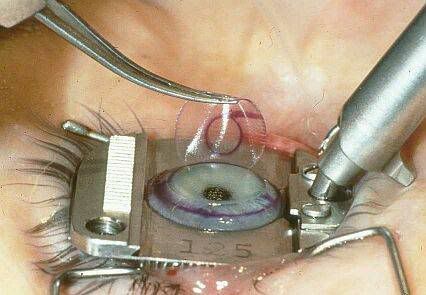
It seems the optho guys who just do LASIK want to convince you that they're the one who should do your procedure because they do so many every day. They caution you about those other guys who just do a couple on the side to pad their income. I think it is important that a practice do a critical number of them and has the best resources. But, apart from having the best machince, since the flap is the most technical step, if the optho guy is a good surgeon he is gonna make a good flap. I don't see how an optho guy who couldn't hack it in the OR can say he has anything over another optho surgeon who does complex lense, cornea, and retinal surgeries. Besides, the new microkeratomes are now automated anyways.

Intralase vs. microkeratome
The intralase people make it sound like the microkeratome is a butter knife. Actually, I don't see how a laser is better than a knife. We don't use lasers in the OR or ED because they actually can cause more tissue damage by heating up surrounding tissues and cause more inflammation, which could impede healing. I'm not sure If the data shows any difference, but I don't buy it that a laser is better just because its a laser. The new microkeratomes are just as precise and just as automated. The new ones are actually machine driven. Although they do look a lot like a meat slicers. Give me the meat slicer!

The 15th street people were telling me that the microkeratome was going to forsure result in corneal wrinkling or other abborations and subject me to a higher risk of needing a redo. After considering the issues, I don't see how this could be true. I think flap problems have less to do with what makes the flap and more to do with flap thickness, how the flap is replaced, and healing than anything else. And interlase still requires the surgeon to choose the flap size and thickness, the flap to be manually retracted and the flap to be manually replaced after the procedure.

Wavefront guided vs. Wavefront optomized
Allegretto Wave Excimer Laser at 15th steet is infact only wavefront optomized. It says it in their broshure. And when I asked their people about it they first told me I didn't know what I was talking about and then that its all the same and then it could do both guided and optomized. Haha, nice try.

It is my understanding that the difference between wavefront guided and optomized is that wavefront guided is a truly custom LASIK. The wavefront guided machine will do sophisticated mathematics to measure not only spherical and cylindrical corrections but also "higher-order abberations" (which cause night halos and stars) and correct for those exact abberations. Wavefront optomized measures for higher-order abberations but only uses a pre-set "one-size-fits-all" correction. That't akin to knowing you are far-sighted and just going to the local CVS and picking up reading glasses from the cheap-o reading glasses display. Consequently, only a wavefront guided correction is a true custom LASIK correction.

LASIK on dilated or nondilated eye.
Eye Care One/MCG performs the procedure on a dilated eye. Although having a dilated eye is rather annoying for 3 days, I don't think it matters. MCG says they do it dilated so that they don't overcorrect. 15th strest says they measure the cornea and perform LASIK on an undilated eye so they can treat the eye in its relaxed state. MCG says that paralyzing the ciliary body may help lessen inflammation and mostly because I believe their particular corneal mapping machine requires it. I'm not sure that it matters. The important thing is the if you take the measurements with a dilated eye that you do the LASIK with a dilated eye and visa versa.


Allegretto vs. VISX
EyeCareOne/MCG uses the VISX’s CustomVue WaveFront System, with the newly added Fournier transform wavefront algorithm upgrade to calculate ablation shapes with more precision and individualize treatment to each patient. Additionally the VISX Customvue system offers Iris Registration and Activetrak™ to compensate for intra-operative cyclotorsional movement, and to ensure treatment is delivered to each eye accurately. Allegretto uses an activetrak-like system too but you can't beat a machine that can do fournier transforms.

Wednesday, July 25, 2007

Custom Lasix Questions

I have decided to get laser vision correction surgery also known as LASIK. In addition to shopping around for the best deal I quickly realized that not all LASIK is created equal. As I have been researching the procedure, I have become more familiar with the terms that differentiate regular LASIK vs. custom LASIK, wavefront-guided vs. wavefront-optimized, higher order abberations vs. spherical and astigmatism and all-laser intralase vs. microkeratome. The following is a list of questions I emailed my opthomology resident friend Chris. I will post the answers to these questions at a later date.

What I have learned so far is that I definately want custom LASIK. In addition to correcting for the typical spherical abberation and astigmatism, custom LASIK also corrects for other "higher-order" imperfections in the cornea which cause glare, halos, stars, contrast, and night vision problems. Custom LASIK uses the same technology used by modern telescopes to correct for atmospheric distortion. I have problems with night halos and stars and measurements clearly show I have a promenent Coma abberation, so custom LASIX is what I want. Unfortunately, there are other issues to consider.

Intralase vs. microkeratome
I can't really get a good sense on the internet about the pro's and cons of Intralase to make the corneal flap vs. using a microkeratome. The guys who use the ketatome say that using the intrlase technique may have longer healing time and that they have been doing great flaps for years with the microkeratome. The guys who use the Intralase say that the laser is more precise and results in less chance of a winkled cornea (abberation) and the need for a redo later. Intralase people seem to ascribe all future redos to a failure of the microkeratome. I doubt this. Is there a downside to Intralase?

Wavefront guided vs. Wavefront optomized
The LASIK clinic on 15th street use intralase and the Allegretto Wave Excimer Laser. They claim it is wavefront-guided but I see some internet info which say some Allegretto machines are only wavefront-optimized which means it is not truely custom LASIK and the higher-order abberations are corrected using some pre-programed values and not actual precise measurements of your cornea. Do you know if that clinic does true wavefront-guided or just wavefront-optimized? They say its wavefront-guided.

Microkeratomes and Quality of Flap
I didn't appreciate it at the time but it sounds like making the flap is a big deal. Is it a big deal? I am wondering what kind of microkeratome Dr. Bogorad uses. Is there anything special about it? Is is a Bouch & Lomb or AMADEUS II or Zytopic XP? Does it really matter? Does Dr. Bogorad make good flaps? Would he be doing the flap or a resident. If you were helping, would you be doing the flap. Do you think I should have you or another resident do the flap? Are flaps really that difficult to do? I am willing to pay full price if the flap is that critical.

Thickness of Flap
Are thick flaps better than thin flaps. Someone was bragging about their Amadeus II making thin flaps but then I read that thin flaps are more likely to develop a wrinkle. My corneal thickness is over 500 microns which is twice the cutoff of 250. So, Dr. Bogorad or whoever should not be constrained when making a flap.

Size of Flap
Also, the Intralase poeple seem to make a big deal about the size of the flap. The laser supposedly makes a nice big even flap so that a night when your pupil dilates you have less chance of the corneal scar intering into the visual field causing night halos or stars. However, Dr. Bogorad's people assure me that they make big flaps.

LASIK on dilated or nondilated eye.
I wasn't sure if Dr. Bogorad does LASIK on a nondilated or dilated eye. It seems to me that I remember the optho tech saying they do it on a dilated eye. Does this determine how big of a corneal flap you can make? The reason I ask is that I had 2 eye exams yesterday; one not dilated and one dilated. Well, my presciption seemed to be somewhat different dilated than nondilated. My nondilated exam presciption (spherical and astigmatism correction) turned out to be similar to my past presciption. And when they were corrected I could see 20/20 and nearly 20/15. But after my eye was dilated I could see 20/20 but not as well as before and I think the correction numbers where also different. So, I guess I am asking what numbers will they put in the machine. I suppose that if they dilate my eye they should use the dilated numbers and if they dont dilate my eyes during LASIK that they should use the nondilated numbers? What I am really asking is, which is better, not dilating the eye and using the interlaze or dilating the eye and using the microkeratome? Why do you bother to dilate the eye at all. Do you need to dilate the eye to cut a big flap?

Wednesday, July 18, 2007

Envirocare and Energy Solutions

Nuclear power can be one of the cleanest sources of energy. It's the making of nuclear weapons that is dirty. Uranium is a naturaly occuring element in the Earth's crust. Uranium ore is comprised of two major isotopes; U238 and U235. What is an isotope? The smallest unit of an element that still retains the physical properties of that element is the Atom. Atoms are made up of electrons, protons, and neutrons. Protons and neutons comprise the nucleus of the atom, while electons form energy shells surrounding the nucleus. While the electons and protons do not vary for a given element, the neutrons can vary without changing the element. An example of this is carbon-14. Most carbon on Earth is carbon-12 with 12 electrons, protons, and neutrons. But a small amount has 14 neutrons instead of the usual 12. The ratio of C12/C14 is used by scientists to date ancient carbon-containing samples like fossils.

Like carbon, Uranium exist as multiple isotopes. 99% exists as U238, while less than 1% exists as the radioactive/fissionable U235 isotope. Neutrons stabilize the nucleus of an atom. U235 with 3 fewer neutrons, does not contain enough neutrons to stabilize such an enormous nucleus. Consequently, U235 atoms will spontaneously split, releasing additional neutrons and enormous amounts of energy. The brake-down products of this natural radioactive decay includes smaller atoms such as lead, and radon gas. Radon that many people worry about in the basements of their homes is the by-product of the radioactive decay of naturally occuring U235 found in the Earth's crust.

Because uranium exists mostly of the non-radioactive U238 isotope, it must be processed before it can be used as fuel in a nuclear reactor. But, separating isotopes is not an easy or inexpensive process. To purify and consentrate U235 from U238, the metal is converted into a gas which is spun in an ultracentrifuge. The sliqht difference in mass is enough to separate U235 from U238. The gas is then converted back into a metal (Zirconium) which is then processed into fuel rods for use in a nuclear reactor core. Now the purifying and processing part is the hard part. And because it's so expensive, the process is absolutely clean; not an atom of U235 is wasted. The left-over U238 is not radioactive and is used by the military as tank armor and as depleted uranium in armor piercing munitions.

Making electricity from reactor-grade uranium is easy. Have you ever seen Indiana Jones and the Temple of Doom. It's kinda like when Indiana places the Shinkara Stones next to each other causing them to glow. That's how uranium works. You simply get enough U235 in one place and it heats up. If you reach critical mass, then you get a self-sustaining reaction where neutrons from the fission of one U235 cause the fission of neighboring U235 and so-on causing a nuclear explosion. Inside a reactor core, U235 is separated into fuel rods which are separated by a series of neutron absorbing boron control rods which prevent the U235 fuel rods from overheating and melting (meltdown) or exploding. The fuel rods and control rods are placed in a pressurized water boiler. The control rods are remotely removed from inbetween the fuel rods, the rods heat up and heat up the surrounding water making steam which then is used to drive the turbins of electric generators.

You don't need 100% U235 to run a nuclear reactor. Reactor grade uranium is only 3-4% U235. On the other hand, weapons grade uranium is 90% U235. So, instead of purifying uranium to weapons grade purity, the US has adopted a cheaper and dirtier method of obtaining large amounts of fissionable material for bombs. Plutonium. Making plutonium is easy. You simply put U238 next to U235 and you make Pu239. Separating Pu239 from U238 is easy. Becuase Pu and U are different elements they have different chemical properties and can be separated using solvents. However, that creates 2 problems. First, you created something radioactive out of something that originally wasn't radioactive and Second, you have all this left-over solvent with traces of radioactive Pu239 in it.

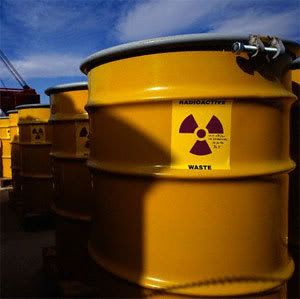
I am living in Augusta, Ga which just so happens to be home to one of the nation's most important nuclear labatories, the Savannah River Site. The SRS is the country's center for putonium production and processing. Consequently, after decades of bomb making, SRS is full of thousands of barrels of toxic mixed waste and radioactive sludge left over from separating Pu239 from U238. Already, the barrels of high-level mixed waste are rusting, the concrete liners are cracking and radioactive solvent is seeping into and contaminating local ground water.

Fortunately, SRS scientists have come up with an ingenious way to help this situation. The process is called vitrification or glassification. Currently, the tens of thousands of barrels of solvent are undergoing a process whereby the solvent is safely evaporated away leaving only a radioactive tar or precipitate salt behind which is then encased in glass, which is encased in concrete and then steel. These new containers are being prepared for safe shipment to a permenent repository at Yucca Mountain.


Fuel rods don't last forever. On average, a fuel rod is changed every 3 years . Within a reactor core, 1/3-1/4 of the fuel rods are replaced every 12-18 months. This is because, as the controlled fission occurs, fission products build up and poison the reaction. The fuel rods themselvs can become brittle as the uranium metal degrades into byproduct salts. The fuel rods can fracture if not replaced. This usually leaves a large percentage of unreacted U235 which some countries like France recycle. However, others are against recycling because it creates more mixed waste and radioactive salts that would also require disposal. The US produces plenty of U235 and therefore currently practices a "use once" policy for its fuel rods.

Utah is one of the largest sources of uranium ore in the world. Expensive oil and fears of global warming are triggering a new uranium mining and processing boom in Utah. Fear over nuclear energy hurt the the uranium economy in Utah during the 1980's and 90's. Uranium processing companies which operated in the 1940's and 50's left behind large tailing piles and contaminated soil which later became EPA superfund sites. One of these sites was located in South Salt Lake. Thousands of tons of tailings and contaminated soil were trucked from the old processing factory which was once outside city limits in 1950 but now was in the middle of residental section of Salt Lake City today. All that dirt was moved to a dump site in west Utah dessert.

Not long after, a company bought desert realestate nextdoor to the dump site and asked the state for permission to create a business there to dispose of medical-grade and low-grade radioactive waste. Utah approved the request and Envirocare was born. Other states like Washington, Denver and South Carolina have similar companies but Envirocare had a huge advantage. Other states taxed their businesses because they feared that after the company had made it's money, the state would be left with a nuclear waste dump which could have caused problems centuries into the future. The collected tax funds were placed in an account to cover future clean-up costs. However, Utah does not tax Envirocare because Evirocare smartly started up shop nextdoor to an existing radioactive dump site. They don't get taxed because the area was already a low-level radioactive waste dump. Consequently, Envirocare can undersell all of its competitors.

A couple of years ago Envirocare got ambitious and wanted to expand the kinds of waste it was approved to receive. It didn't want fuel rods or mixed waste; that's for Yucca Mountain. What it wanted was the contaminated equipment, gloves, and boots, and suits the people who work at places like SRS wear and use while processing the high-level mixed waste. Well, had Envirocare won approval, that would have put waste companies in Colorado and Washington out of business. So, Colorado launched one of the most impressive political campaigns since the state's ski resorts combated Utah's drink-by-the-glass initiative. Colorado sponsored a huge misinformation campaign and sent in representatives to gather names on a petition for a ballot proposal which would have put Envirocare out of business. They were successful in getting the signitures and Envirocare was forced to spead millions of dollars on TV, radio, mailers, and newpaper ads fighting the proposition. The ballot proposition failed and Envirocare won its request to receive the new types of low-level radioactive waste.
Envirocare learned an important lesson about the importance of good public relations. Like many companies, they ignored public relations, but when their competition started the negative PR campaign against them, noone in Utah knew who Envirocare was and readily believed the negative propaganda. I was suspicious when I listened to a presentation in favor of the ballot initiative during a lunch-time meeting and every other side in the presentors powerpoint had a mushroom cloud in it.

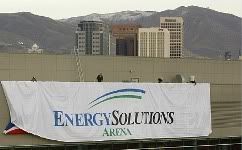
Since that experience, Envirocare has needed to transform its image. First it changed its name to Energy Solutions. And then the company started sponsoring local events such as the Salt Lake Marathon and other charitable events. But the king of them all is that they paid enough money to rename the Delta Center, home of the Utah Jazz, the Energy Solutions Center. They even started advertizing in Augusta, GA on radio and TV. A neighbor who is a nuclear engineer at SRS told me that the waste contracts were up for bid and Energy Solutions was the clear victor. In fact, Energy Solutions just purchased it's South Carolina competitor NUKEM.