A little clarification on Steel and Wootz, becasue there is considerable confusion about what is Wootz, Damask, Bulaut, Damascus steel.
Noone knows how to make Wootz. It is a secret that has been lost for several centuries. Noone has made steel to the quality of Wootz since. Wootz is like 3-5 times stronger than any know modern steel. making Wootz has nothing to do with laminating, forge welding, pattern welding, layering, etc, etc. Japan did use lamination to produce their blades. But pattern welding was how knockoff sword makers tried to imitate Wootz. Pattern welding actually makes weak spots and if you buy ammunition some boxes say that it is not to be used in gun with Damsk or Wootz steel barrels. There have been several cases of the these cheaply made barrels blowing apart.
True Wootz has to do with creating the correct conditions to grow carbon nano-tubes matrix inside the molten iron. Some theorize this had to do with vanadium nucleation sites, and repetative heating and cooling cycles. But, like I said, noone knows. Pattern welding can fake the swirl pattern on Damascus Sabers, but noone knows how to make real Wootz. Wootz steel had extrememly high carbon content over 2% which should result in worthless Cast Iron. But instead of the carbon making the steel brittle, the carbon formed into a carbon nanotube matrix. This nano-steel was extrememly hard, yet flexible and elastic. (Ancient Nanotechology = Cool)
About regular modern and ancient steel. Cooled wrought Iron (ferrite-Faced Centered Cubic structure) cannot disolve signifanct amounts of carbon. If you heat it up to almost molten (910oC), it will phase transition to austenite (Body Centered Cubic) and readily dissolve carbon up to 2%. When the iron is allowed to cool, the carbon will precipitate as cementite. Mixtures of cementite and iron are called pearlite and bainite and are found in steel and cast iron.
To make steel you need to disolve the carbon in molten wrought Iron and then cool it rapidly. Instead of the carbon precipitating as cementite, the carbon will precipiate as martensite. Martensite is the key to non-wootz, non-stainless, ancient and modern steels. The martensite itself is not what is important. What is important is that when martensite forms it changes the configuration of austenite from a Body Centered Cubic configuration to a body-centered tetragonal structure. BCT is what leads to steel.
However, BCT iron full of martensite is extremely hard hard but still brittle. The large martensite crystals needs to be broken down. That is where tempering comes in. BCT iron is then reheated which transforms some of the brittle martensite to transform back into bainite or pearlite or a combination of ferrite and cementite. This is done until the right balance of hardness, brittleness and ductility is achieved. Steel has a mixture of martensite, bainite, ferrite and cementite. But if you see martensite, then you know the iron has been austenized and quenched. tempering only requires gentle reheating.
3 steps for making steel 1.austenizing. 2. quenching 3. tempering.
www.technologystudent.com/equip1/heat1.htm
Bronze was supperior to wrought iron and cast iron in every characteristic. But steel beats Bronze hands down. So, some believe what drove history from the bronze age to the Iron age was a shortage of Tin traded by the phoenecians which produced pressure on countries to invest in steel research. When steel was discovered (think Manhattan Project), and able to be produced in large amounts, the Assyrians used steel chariots and swords to conquer Northern Israel and Egypt. Steel making didnt make your country dependent on foreign tin. Therefore, steel could be made locally, and became the the material of choice.
Steel also has elastic and memory properties that ancient bronze did not. So, steel could be used as a material to make springs and tension bars to store potential energy. Steel spring technology was used later in this way to make seige weapons and cross bows. Steel spring technology was the secret of sucess of the Romans and was involved in the fall of Carthage (end of the Phoenecians).
Wednesday, June 04, 2008

Wednesday, April 23, 2008
Custom LASIK Answers Part 2
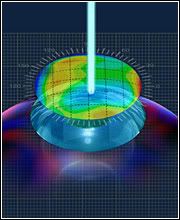 In a previous post I posed a question about why EyeCareOne did my exam and did their laser vision correction procedure on a dilated vs. "relaxed" eye. Last week I went back to the Laser vision correction center and was re-evaluated and I asked them this question: Why do LASIK on a dilated eye while other centers say they perform the procedure on a "relaxed" eye?
1. Their laser has a gaze-tracking feature that works better with a dilated verses the relaxed eye.
2. Have you ever seen those infomercials about a program which promises to improve your vision without the need for glasses in just minutes a day? That product is actually based on a physiologic principle called accommodation. Accommodation is the ability for the lens to change shape making images crisper and sharper. It's kind of like a fine focus which is especially important as an object in focus draws nearer to us. So, the glasses-free program sells information about using a system of "pencil pushups" and other eye exercises to help develop your ability to accommodate. This ability is usually lost or decreased in later life.
So, during my second exam, the optometrist was measuring my spherical and cylindrical correction and she had me read the eye chart after the measurement and commented, "wow, you shouldn't be able to read the chart that well." Well, one reason I was reading the chart better than predicted may have been lucky guessing but the other reason was my ability to accommodate. I guess you could say its a special talent of mine. You see, I have needed glasses since I was 5 years old, but since then, I have never consistently worn them for one reason or another. Consequently, my lens has learned to adapt and compensate or accommodate in this case.
[I wonder if I could use my new-found ability to save the world, or at least make some money?]
In any event, I quickly was convinced of how significant this phenomenon was to my vision. The optometrist proceeded to apply eye drops which dilated my pupils and paralyzed the muscles attached to my lenses. Then she had me read the eye chart again. I couldn't read it at all. Not even the big letters.
I find it curious that the other laser correction centers claim that doing LASIK on a "relaxed," non-dilated eye is better. For one thing, calling a non-dilated eye "relaxed" is a misnomer. The dilated eye is the one that is relaxed. But I think it would have been better to say "natural" because saying "relaxed" is misleading. It is misleading because had I had LASIK done based on a non-dilated exam, I would have been under-corrected. In some cases, patients can be over-corrected. However, by getting correction measurements on a dilated eye, lens accommodation is taken out of the equation as a potential confounding variable which may lead to deterioration of vision later when the ability to accommodate is lost.
If accommodation is such an significant factor in vision, I wonder why other centers ignore it. I can only speculate that it is for convenience.
Monday, March 10, 2008
A Few Links
http://www.fairlds.org/FAIR_Conferences/1999_Early_Christian_and_Jewish_Rituals_Related_to_Temple_Practices.html
http://www.mormonismi.info/jamesdavid/rebutt01.htm
http://www.mormonmonastery.org/230-the-hand-as-a-cup-in-ancient-temple-worship/
http://www.geocities.com/Athens/Parthenon/2671/ECLDSEn.html
http://www.youtube.com/watch?v=rwcG-YfELOI&NR=1
http://www.youtube.com/watch?v=2o0ajpaoJPM
http://www.youtube.com/watch?v=PotAd3Gcgt8&feature=related
http://www.mormonismi.info/jamesdavid/rebutt01.htm
http://www.mormonmonastery.org/230-the-hand-as-a-cup-in-ancient-temple-worship/
http://www.geocities.com/Athens/Parthenon/2671/ECLDSEn.html
http://www.youtube.com/watch?v=rwcG-YfELOI&NR=1
http://www.youtube.com/watch?v=2o0ajpaoJPM
http://www.youtube.com/watch?v=PotAd3Gcgt8&feature=related
Tuesday, February 26, 2008
Near Death Experiences Support Eternal Families
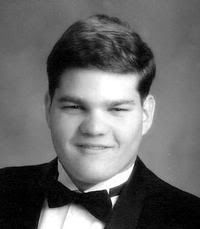 My younger brother Stephen passed away last Monday of complications of pneumonia. Although unexpected, he had been sick for a long time, so his passing was not a total surprise. I am convinced of life after death and the continuation of family relationships in the next life. Stephen had had a near-death experience in the past while clinging to life on a ventilator. During that experience (typical of many other NDEs), he met and spoke with people on the other side who had died who he knew to be family and friends. Although, not his time then, I am confident that his time to pass into the next life had come at last. Stephen died quietly and painlessly in his sleep yet I believe that our relationship will live on forever.
It is interesting how many NDEs involve already deceased family and friends. It seem this would confirm by direct observation that familial relationships continue into the next life. It is unfortunate that other Christian religions have contrived doctrines contrary to this self-evident truth. Family relationships are a treasure which we can lay up in store where theives cannot break in and steal and where moth and rust cannot corrupt.
The assurance of Eternal Families results in LDS funerals which are different than funerals the world over. LDS funerals are reverent and mournful, but never grief- or despair-filled. There is always a bright spirit of hope, peace, comfort and faith that the deceased who has keep the faith is in a better place awaiting a literal resurrection and our future reunion.
I have since wondered why God wouldn't have just taken Stephen to heaven when he was in the hospital and on the ventillator and in severe septic shock. But then I realized, after a phone converstion with our mother, that had Stephen died in the hospital he would have died a mental patient. That is because he had just gotten out of a mental health hospital for an exacerbation of paranoia. As it worked out, he was able to be nursed back to health, return to college, and play the trumpet in the university marching band, symphonic band, and jazz band. I am not really sure how he would play the trumpet, a wind instrument, during the day and go to bed hooked up to oxygen at night. In any event, he didn't die a mental patient, but he died as a student, a musician, and a faithful disciple of Christ.
Wednesday, February 13, 2008
10 Advancements in Trauma, Tactical, and Battlefield Medicine
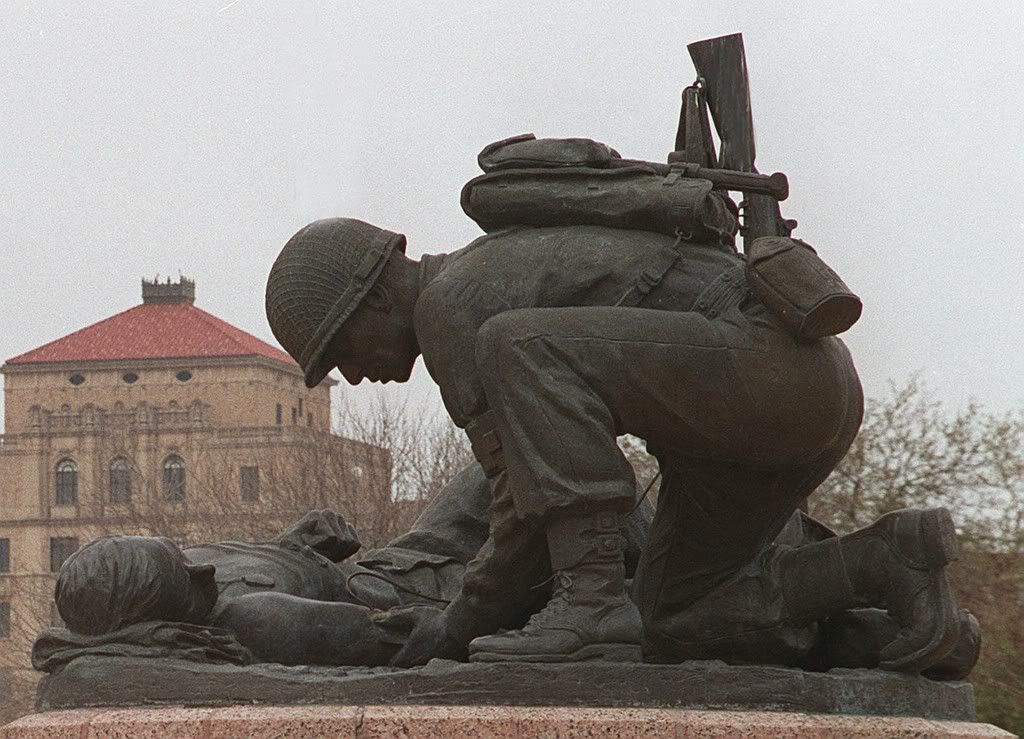 I enjoyed an excellent Grand Rounds lecture by Frank K. Butler, Jr., M.D. CAPT MC USN (RET), Medical Consultant for Naval Operational Medicine Institute in Pensacola, FL entitled “Tactical Combat Casualty Care: Update 2008.” Dr. Bulter outlines a number of advancements in trauma care which the military has been implementing and showcased the outstanding survivability data as a direct result of these developments.
There are some injuries for which nothing can be done on the battle field. Soldiers stuck in the head or through the heart cannot be saved. Unfortunately, a great percentage of soldiers die from injuries that could easily be saved with minimal resources and training. But new revolutionary advancements in Trauma and Tactical Medicine during the Afghanistan and Iraq wars have demonstrated significants improvements in survivability on the battle field over the past 50 years.
Mortality of Injured: WW2: 30%, Vietnam: 20%, Iraq 10%.
1. Tourniquets: Used to stop large arterial extremity bleeding as a last resort after direct pressure bandages. New designs can be easily placed with only one hand by the injured person.
2. Clotting Agents: HemCon and Quick Clot can be poured or packed into deep puncture wounds to stop bleeding.
3. Interosseous Access (IO): Using a small drill and cutting catheter, a line can be placed quickly into the sternum or tibia. Fluids, blood, antibiotics, and pain medicine can all be given through the IO line into the bone itself. IO lines have demonstrated very low rate of infection and are much less prone to failing like typical IVs.
4. Permissive Hypotension: In a bleeding patient, blood pressure should only be maintained to the point that consciousness is maintained. Resuscitating a patient to a normal blood pressure will blow newly formed clots off bleeding sites causing more severe bleeding.
5. Intravascular Volume Expanders: Traditional resuscitation fluids like NS and LR stay inside the vasculature for only 45 minutes before leaking out. Products like Hespan pull fluids into the blood vessels and stay in circulation for days. Also, medics aren't weighed down carrying heavy bags of IV fluids. Hespan does not carry oxygen so upcoming artificial blood products which do carry oxygen will be the exciting next development.
6. Oral Antibiotics: Moxifloxicin and other newly formulated antibiotics have 100% bioavailibility when taken orally as compared to IV dosing. An injured patient can easily receive antibiotics by mouth without needing a high maintenance IV. Using these antibiotics, wound infection rates have virtually evaporated to near zero.
7. Fentanyl Suckers: a powerful pain medicine sold under the trade name Actiq can easily and quickly be administered by mouth without using a high maintenance IV and removed if the patient becomes too sedated and experiences respiratory depression.
8. Fresh Frozen Plasma: Studies from Afghanistan and Iraq show that bleeding patients have better survival outcomes when given Fresh Frozen Plasma (FFP) in a 1:1 ratio with Packed Red Blood Cells (PRBCs).
9. Thorocostomy Needles: Gun shot wounds to the lung kill patients because air leaking out of the injured lung fills the chest until the pressure stops the heart from pumping blood. This is called cardiac tamponade resulting from a tension pneumothorax . This is easily prevented by inserting a needle and catheter into the chest wall allowing the trapped chest air to escape. Newer thoracostomy needles are longer and larger to facilitate this procedure on thick chested soldiers.
10. Advanced Airways: Many wounded soldiers who are knocked unconscious die simply because they suffocate on their own tongue. A simple chin lift or head tilt by another soldier is all that is needed many times to save a life until the soldier regains consciousness and can maintain his own airway. However, it can be very inefficient use of resources for a medic to hold open one airway while a handful of other wounded slowly bleed to death around him. So, new devices have been invented, tested, and successfully implemented which can be inserted into the airway and assist in respiration.
Subscribe to:
Posts (Atom)


